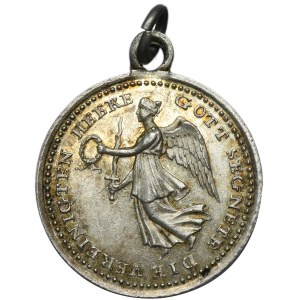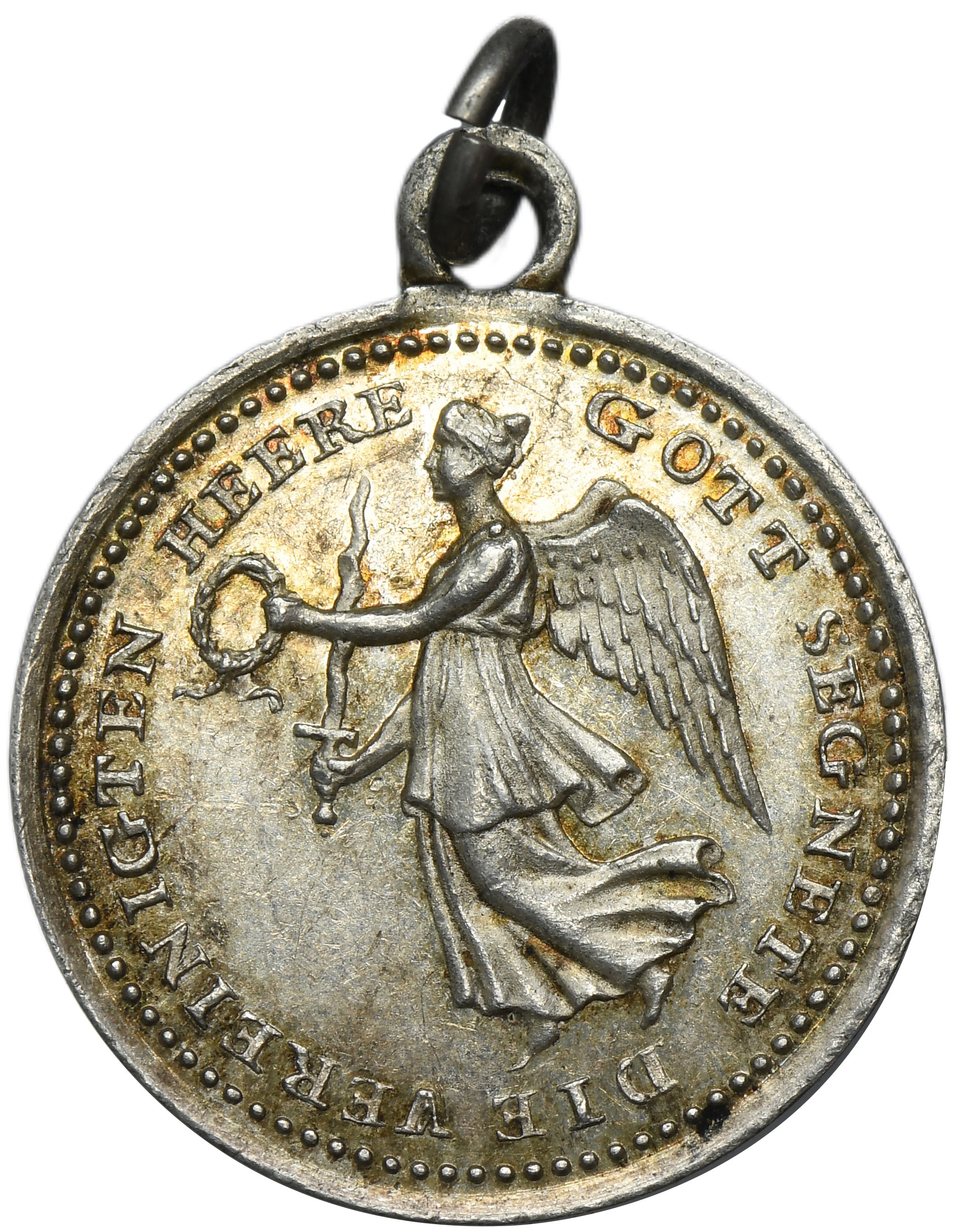
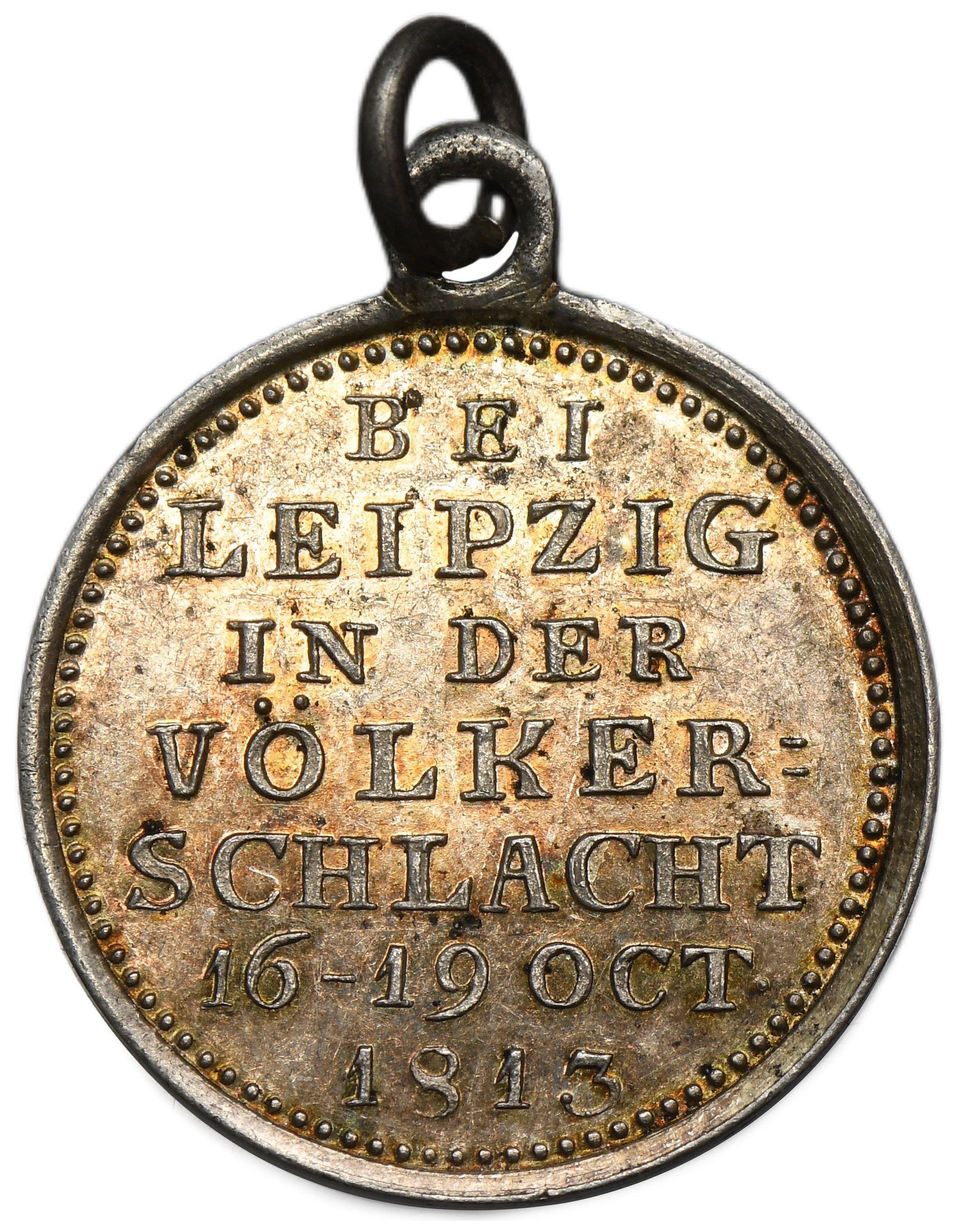
A small silver commemorative medal, known as a Siegespfennig, struck to commemorate the victory of the Sixth Coalition at the Battle of the Nations at Leipzig, fought from 16 to 19 October 1813. Designed by Daniel Friedrich Loos, it belongs to a series of miniature medals celebrating victories over Napoleon’s forces.
The Battle of Leipzig was the largest engagement of the Napoleonic Wars, involving more than half a million soldiers from numerous European states. Napoleon’s army faced the combined forces of Russia, Prussia, Austria and Sweden, commanded by, among others, Prince Karl Philipp von Schwarzenberg, Gebhard Leberecht von Blücher and the Swedish Crown Prince Charles John Bernadotte.
After four days of exceptionally fierce fighting, the numerical superiority of the coalition forced Napoleon to retreat. During the evacuation, the bridge over the White Elster was demolished prematurely, cutting off part of the French army. Prince Józef Poniatowski, whom Napoleon had appointed Marshal of France only three days earlier, drowned while attempting to cross the river.
The defeat ended French domination in Germany, accelerated the collapse of the Confederation of the Rhine and forced Napoleon to withdraw his army beyond the Rhine. The victory opened the way for the Allied invasion of France in 1814.
The obverse depicts the winged goddess Victory holding a flaming sword and a laurel wreath. The legend GOTT SEGNETE DIE VEREINIGTEN HEERE translates as “God blessed the united armies.”
Fitted with a suspension loop and ring.
An interesting memento of the decisive Battle of the Nations, which ended Napoleon’s domination of Germany and determined the outcome of the 1813 campaign.
Obverse: winged Victory holding a flaming sword and a laurel wreath
GOTT SEGNETE DIE VEREINIGTEN HEERE
Reverse: inscription
BEI / LEIPZIG / IN DER / VÖLKER- / SCHLACHT / 16–19 OCT. / 1813
Silver, diameter 15 mm, weight 1.38 g