
A posthumous medal of Maria Amalia Mniszech, née Brühl (1736–1772), one of the most influential women in the political life of the Polish-Lithuanian Commonwealth during the early years of the reign of Stanisław August Poniatowski.
Maria Amalia Fryderyka was the only daughter of Heinrich von Brühl, First Minister to Augustus III of Saxony and one of the most powerful political figures of the Saxon era. Raised at the Dresden court, she received a thorough education, spoke several languages and, from an early age, moved within the circles of Europe’s political elite. Her marriage to Jerzy August Mniszech, Court Marshal of the Crown and one of the leading representatives of the Polish magnate elite, united two exceptionally influential political families.
Her involvement in the Bar Confederation secured her a particular place in history. Maria Amalia Mniszech was not merely a supporter of the movement; according to contemporary accounts, she was among those who exerted significant influence over the political activities of the Confederates. Edward Raczyński went so far as to describe her as the “soul” of the Confederation, emphasizing her authority, diplomatic abilities and influence over its leaders. Her opinions were also taken seriously by French representatives attached to the Confederates, including Charles François Dumouriez and Baron de Vioménil.
She died in Dukla on 30 April 1772, at only 35 years of age. Her death came at a particularly dramatic moment in the history of the Commonwealth, during the final phase of the Bar Confederation and in the year of the First Partition of Poland. She was buried in Dukla, where her impressive funerary monument survives to this day.
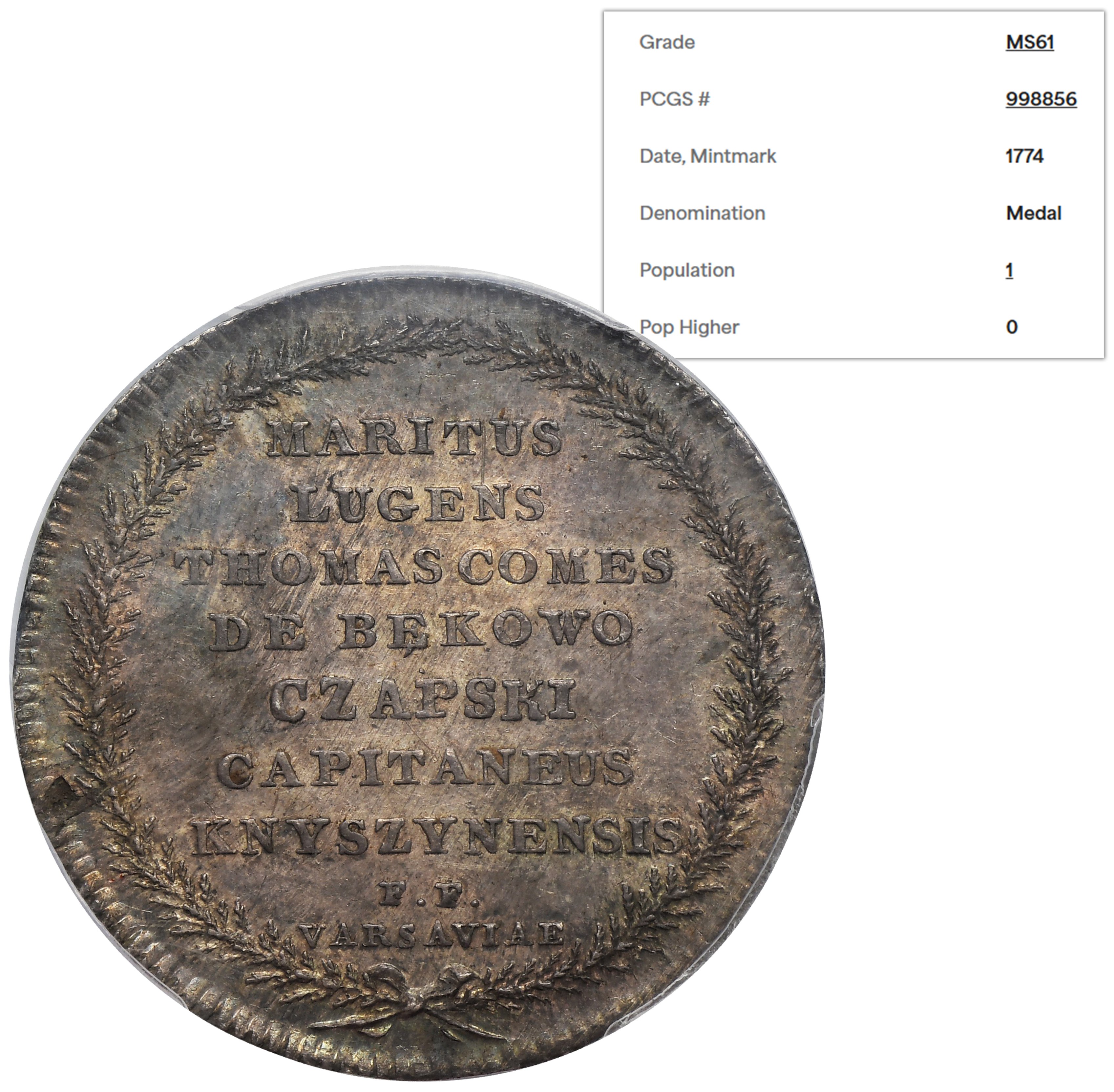
The medal was commissioned by her grieving husband, Jerzy August Mniszech, as a personal commemoration of his deceased wife. The Latin inscriptions go beyond simply recording her name and dates, forming an elaborate tribute to her piety, virtues and marital devotion.
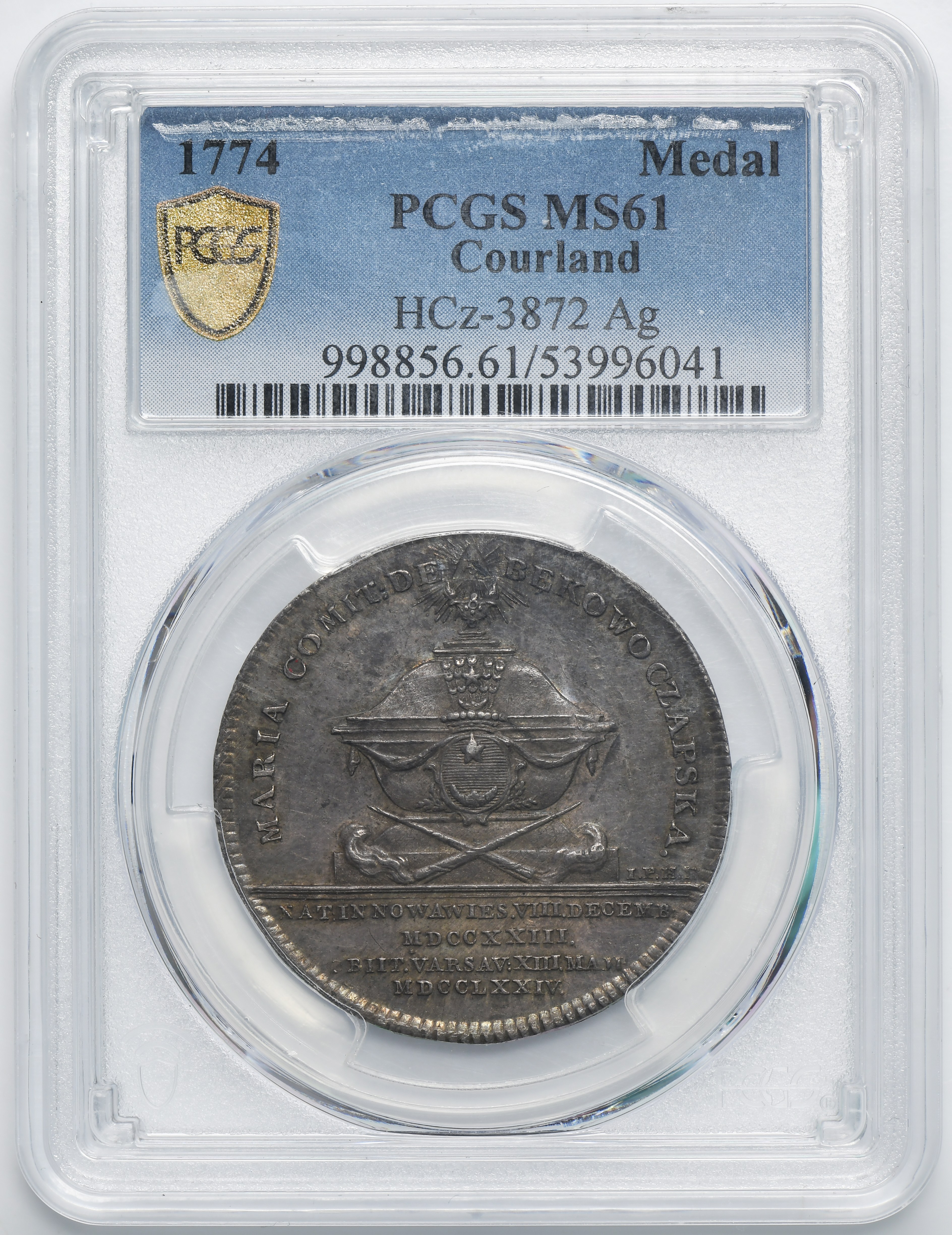
Its Mint State preservation is confirmed by the PCGS MS62 grade.
The sole and highest-graded example in the PCGS Population Report.
A medal of exceptional historical significance, commemorating a woman who played an important role in the political life of the late Polish-Lithuanian Commonwealth and in the history of the Bar Confederation.
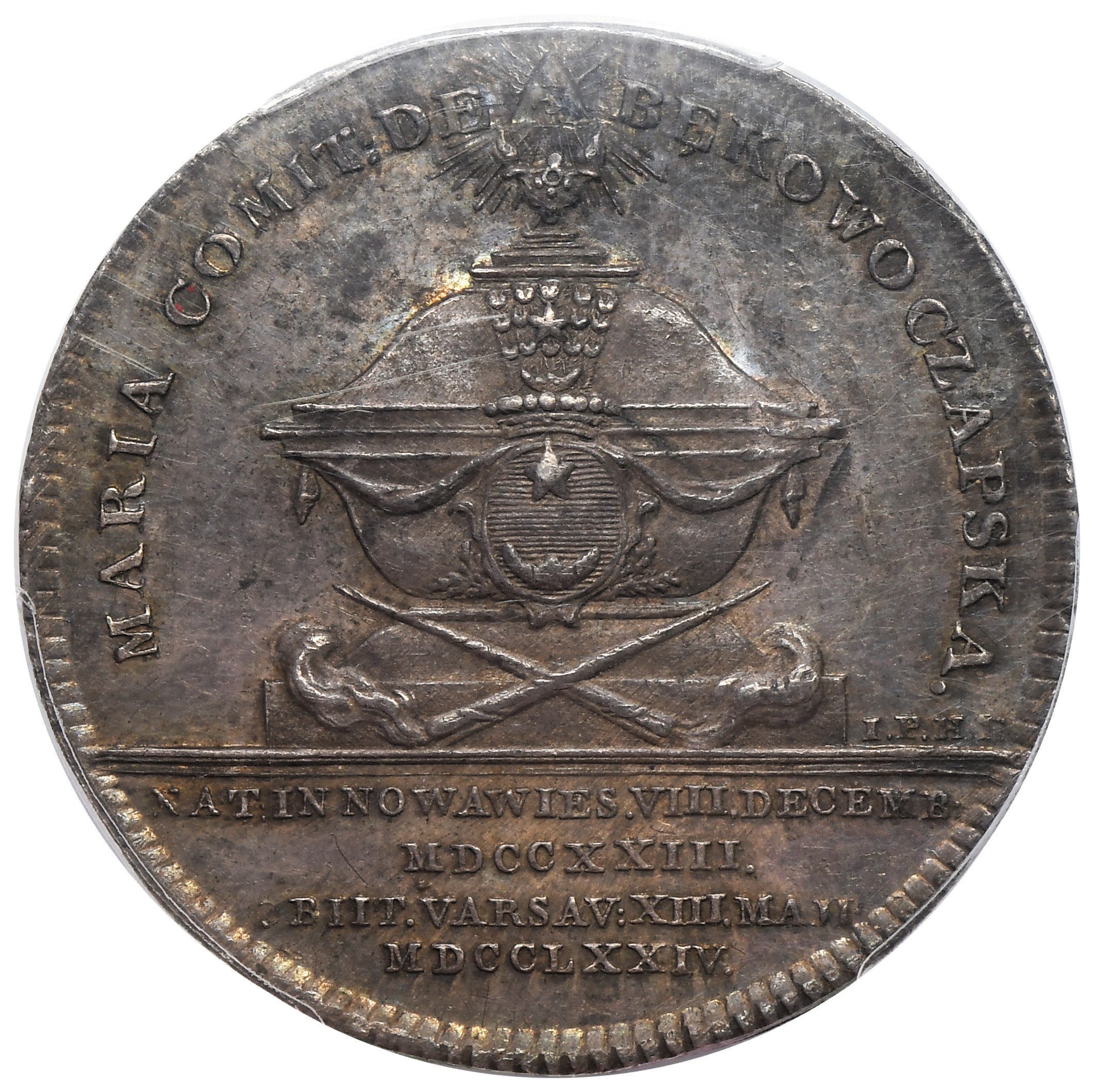
Obverse: a monumental sarcophagus bearing the Leliwa coat of arms, in front of which are two crossed, downward-pointing torches, a traditional symbol of death and extinguished life. A burning lamp stands upon the sarcophagus, above which radiates the Eye of Providence, giving the composition a religious dimension and referring to the hope of eternal life. Beside the sarcophagus, the signature I.P.H.; in the exergue:
NAT. IN NOWAWIES. VIII. DECEMB. / MDCCXXIII. / OBIIT. VARSAV. XIII. MAJI / MDCCLXXIV.
MARIA COMIT. DE BĘKOWO CZAPSKA
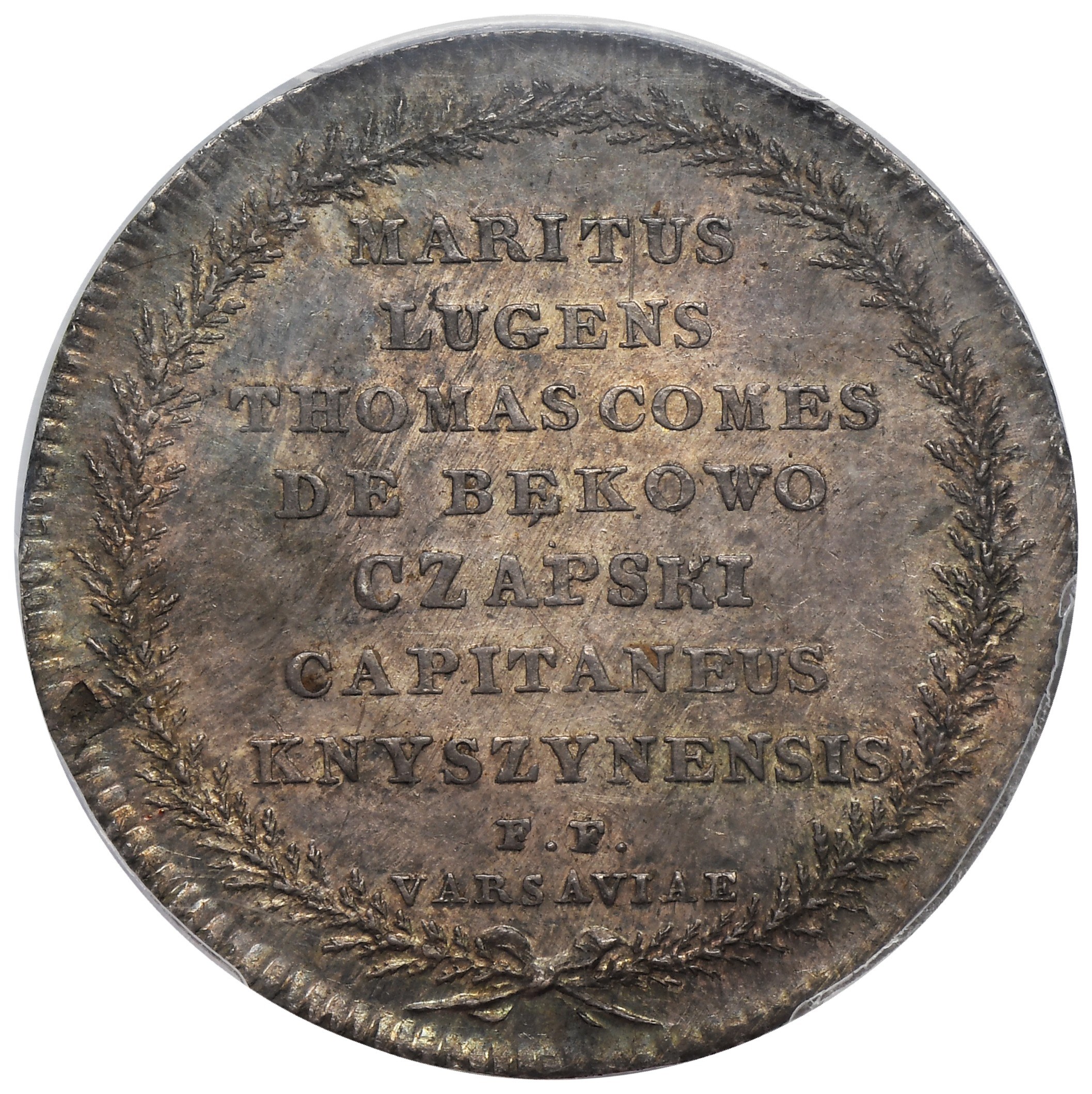
Reverse: within an elaborate myrtle wreath, traditionally associated, among other meanings, with love and the marital bond, a multi-line inscription:
MARITUS / LUGENS / THOMAS COMES / DE BĘKOWO / CZAPSKI / CAPITANEUS / KNYSZYNENSIS / F.F. / VARSAVIAE
Silver, diameter 34 mm











