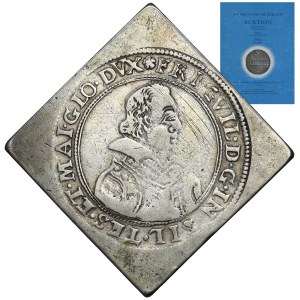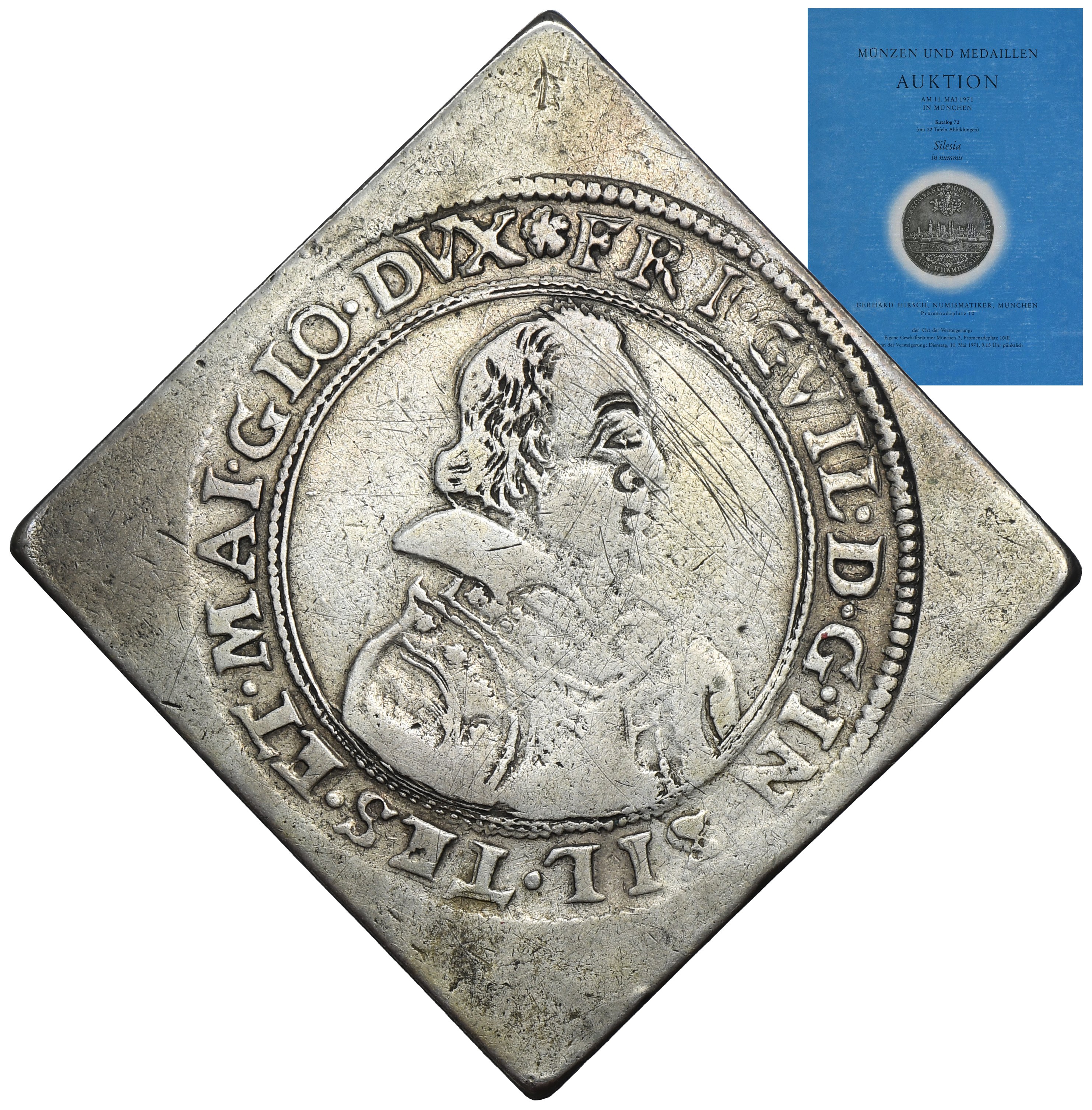
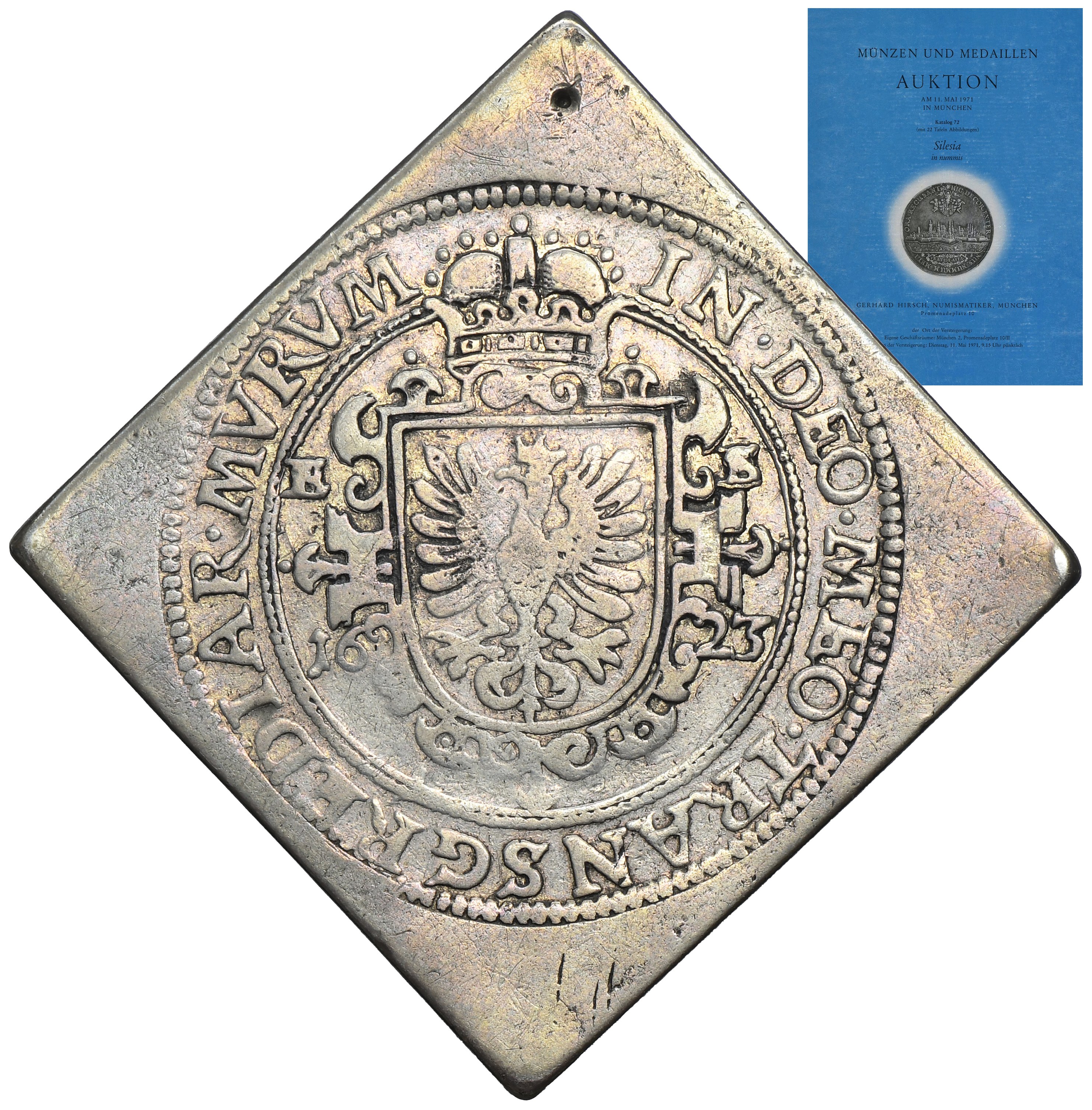
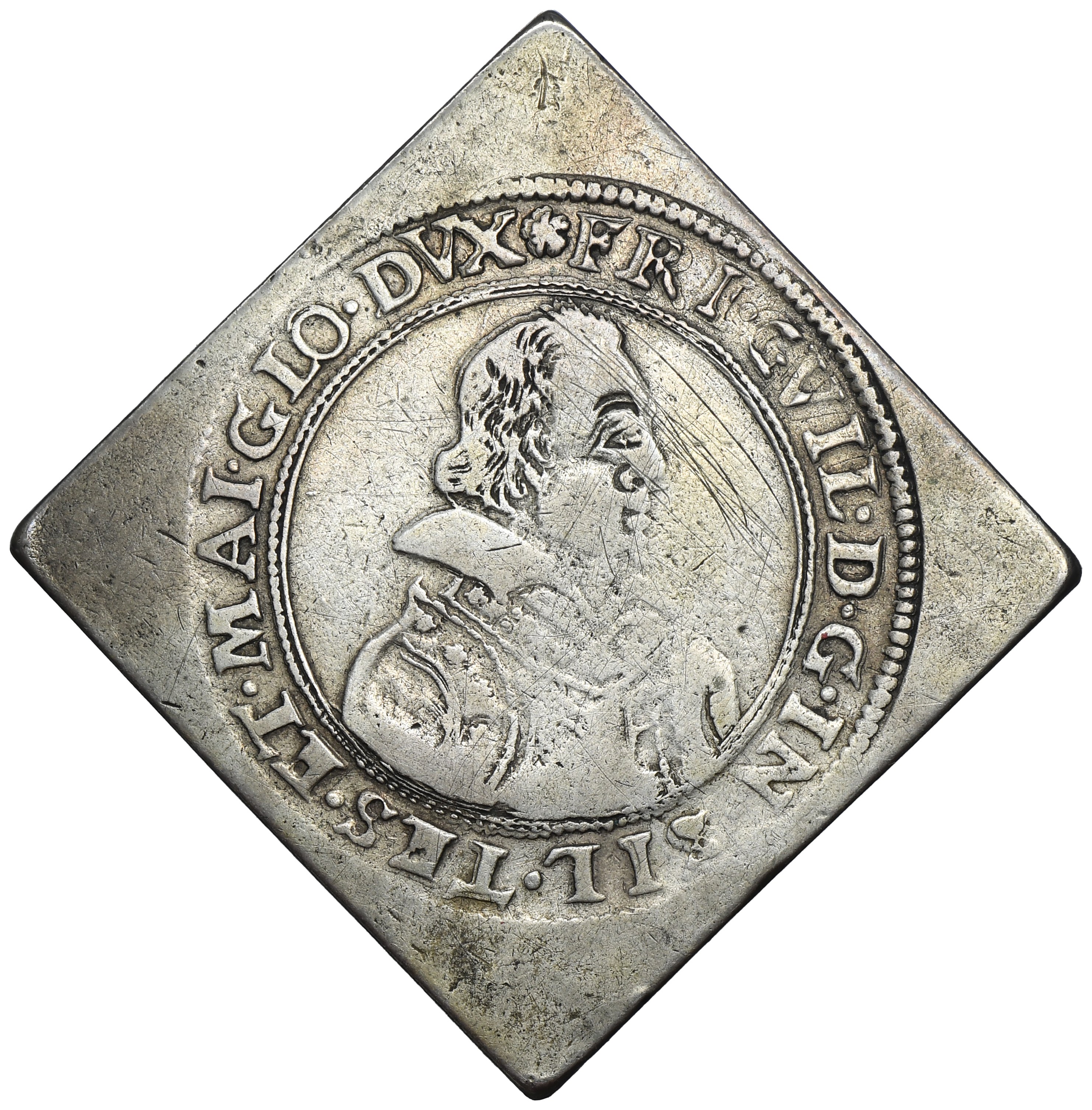
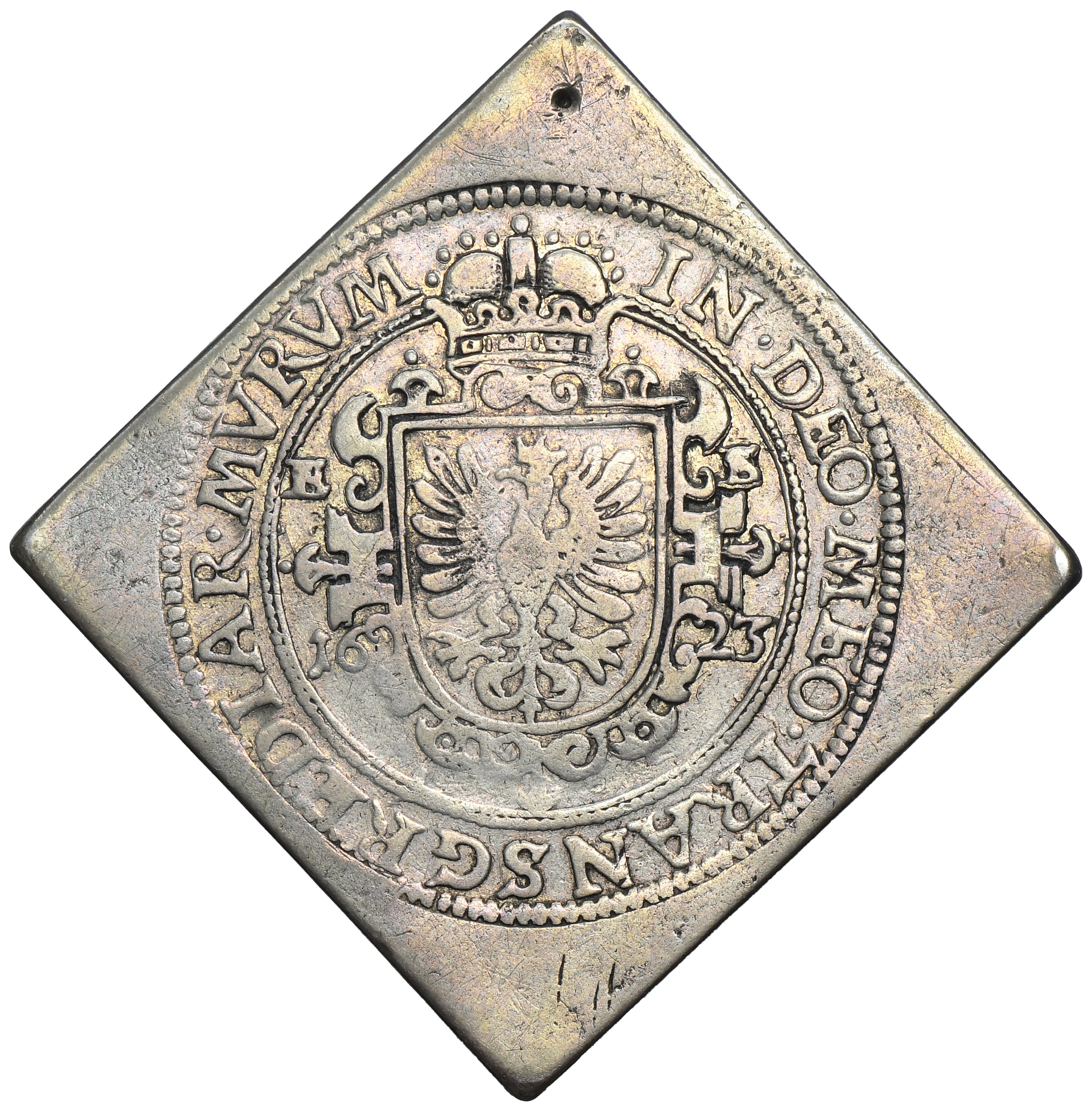
Unique and exceptionally interesting issue of the coinage of the Duchy of Teschen, known exclusively from the presented specimen. Coin unlisted in the basic Friedensburg-Seger and Davenport catalogues.
Half-thaler klippe of Friedrich Wilhelm dated 1623, bearing the mysterious initials E-S, which to this day have not been unequivocally linked to any known mint master or specific mint.
Frederick William (1601–1625) was the last male representative of the Teschen line of the Piast dynasty. He assumed rule over the Duchy of Teschen after the death of his father, Adam Wenceslaus, although he spent a significant part of his youth outside the duchy. His short reign coincided with the exceptionally turbulent period of the Thirty Years’ War and the great monetary crisis known as the Kipper- und Wipperzeit. In the years 1620–1624, the mints in Teschen and Skoczów struck primarily coins of small denominations in his name. Issues of high denominations, however, rank among the greatest rarities of Teschen coinage.
Of particular significance in this respect is the year 1623, when the exceptionally rare thalers of Friedrich Wilhelm and the presented half-thaler klippe were struck. Thalers from this year are attributed to the Cieszyn mint and signed by the mint master Hans Loss, who was active there. The half-thaler klippe, however, bears the unknown initials E-S, which means that the identity of the person responsible for its striking remains unresolved. Numismatic sources indicate the exceptional character of this issue and the lack of identification of the mint master behind the initials E-S.
The most probable place of striking remains the mint in Teschen. This is supported primarily by the composition and character of the issue, as well as by the reverse legend IN DEO MEO TRANSGREDIVAR MVRVM, referring to legends encountered on the exceptionally rare thalers of Friedrich Wilhelm struck at the Teschen mint. This maxim, in its correct Latin form In Deo meo transgrediar murum, means “With my God I will cross the wall” and gives the issue a distinctly devotional character.
In Edmund Kopicki’s catalogue, the rarity rating R* was assigned together with a valuation at the level of c.a. (cena amatorska – collector’s price).
The presented specimen is also distinguished by its excellent provenance documented for more than half a century. In 1971, it was offered as lot 489 at the famous specialist auction Gerhard Hirsch 72 “Silesia in nummis” in Munich. It was an extensive auction devoted to Silesian numismatics, comprising 841 lots and 22 plates of illustrations. In the Hirsch catalogue, the presented specimen was described as “Unikum”. Subsequently, after 35 years, the coin appeared on the market again at Fritz Rudolf Künker Auction 107 in 2006, lot 1119. The provenance from Hirsch 1971, lot 489, and Künker 2006, lot 1119, is also confirmed by later auction studies of this coin.
Shallow strike, with a small hole visible on one corner from the reverse side.
Scratch on the obverse.
A coin of exceptional significance for Silesian coinage and the history of the Duchy of Cieszyn. Not only extremely rare typologically, but – according to the current state of knowledge – known exclusively from this single specimen. The documented presence of this very specimen on the numismatic market as early as 1971, its reappearance only in 2006, and the absence of any further known specimens additionally emphasize its unique character.
The only known specimen – an absolute UNIQUE PIECE of Cieszyn coinage!
Obverse: bust of the duke, facing right
FRI GVIL D G IN SIL TES ET MAI GLO DVS
Reverse: crowned cartouche with the coat of arms of the Duchy of Cieszyn, letters E-S on the sides, date 16-23 at the bottom on the sides
IN DEO MEO TRANSGREDIVAR MVRVM (correctly In Deo meo transgrediar murum, meaning With my God I will cross the wall)
Silver, dimensions 34 x 34 mm, weight 22.58 g