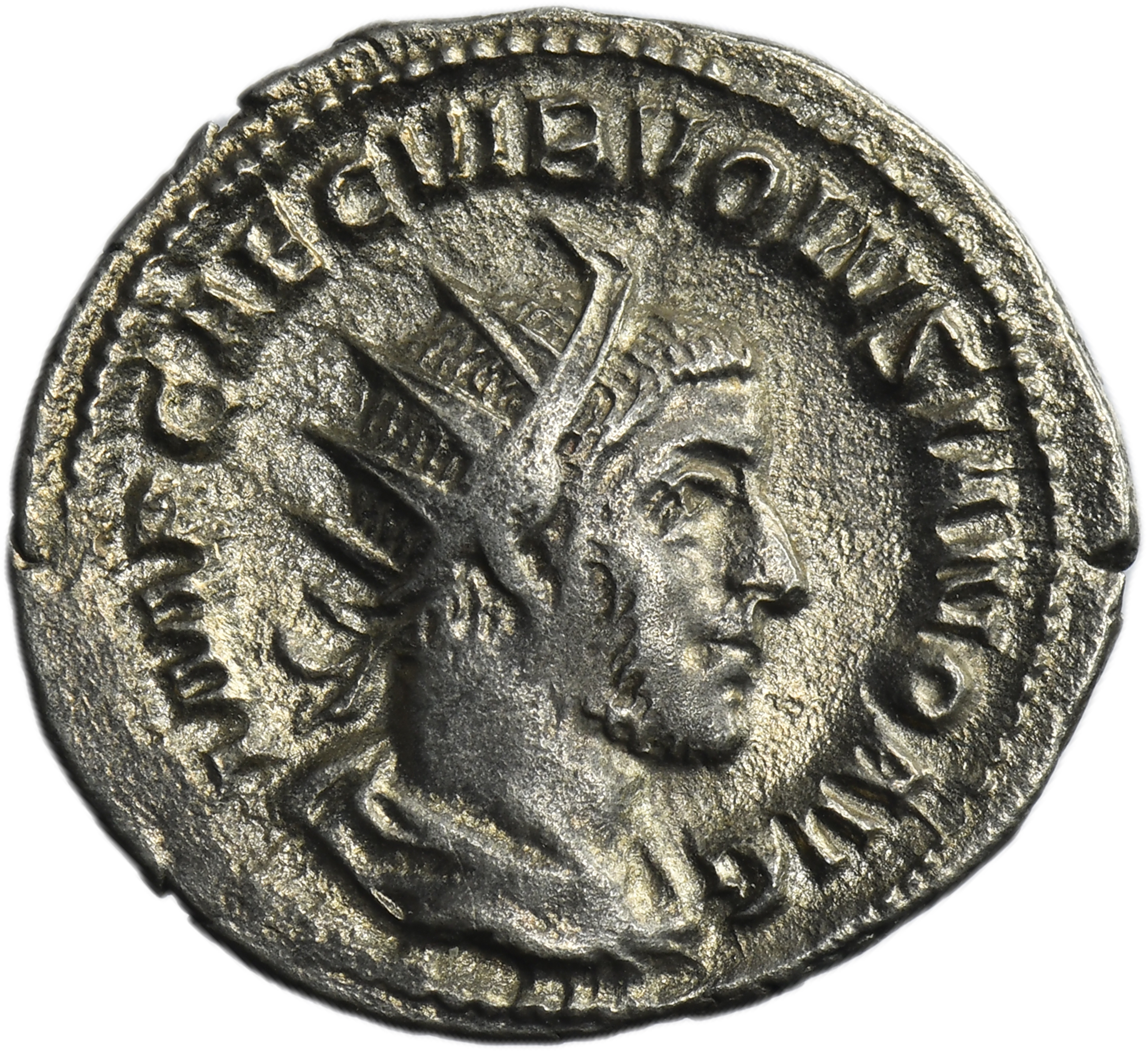
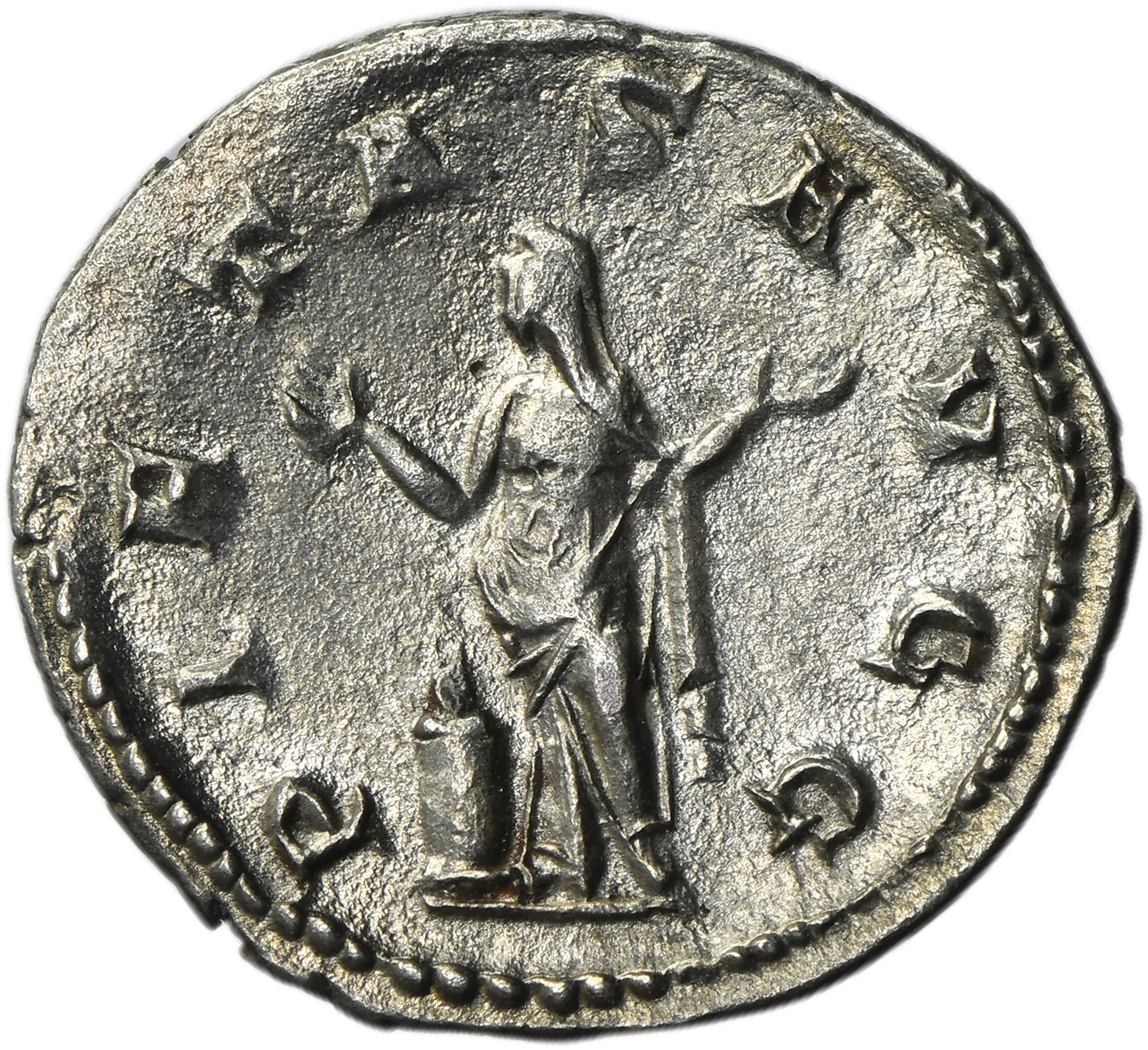


Antoninian of Volusianus (AD 251–253), struck at the Rome mint, belongs to issues of his joint reign with Trebonianus Gallus, in which the religious dimension of imperial authority and the concept of piety as a foundation of state order were strongly emphasized.
The obverse presents a radiate, draped and cuirassed bust of the emperor facing right, with the legend IMP CAE C VIB VOLVSIANO AVG, giving his name and titulature as imperator and augustus. The radiate crown denotes the antoninianus denomination, which at this time functioned as the principal coin in circulation.
The reverse depicts Pietas standing left, raising her hands in a gesture of prayer, with an altar to the left, and the legend PIETAS AVGG. Pietas, as the personification of piety and proper relations between humans and the gods, was a central motif in imperial ideology.
The raised hands clearly refer to an act of prayer or sacrifice, while the presence of the altar underscores the ritual character of the scene. This representation belongs to a well-attested iconographic repertoire in Roman coinage, emphasizing the emperor’s role as guardian of the state religion.
The legend PIETAS AVGG (“the piety of the Augusti”) highlights the shared religious devotion of the rulers and their function as guarantors of harmony between the divine and the state. In the context of the mid-3rd century crisis, marked by political instability and military threats, this motif carried particular propagandistic significance.
Roman Imperial
Volusian (251-253), Antoninianus 251-253, Rome mint
Obverse: radiate, draped and cuirassed bust right
IMP CAE C VIB VOLVSIANO AVG
Reverse: Pietas standing left, rising both hands, altar to left
PIETAS AVGG
Diameter 22 mm, weight 3.51 g











