
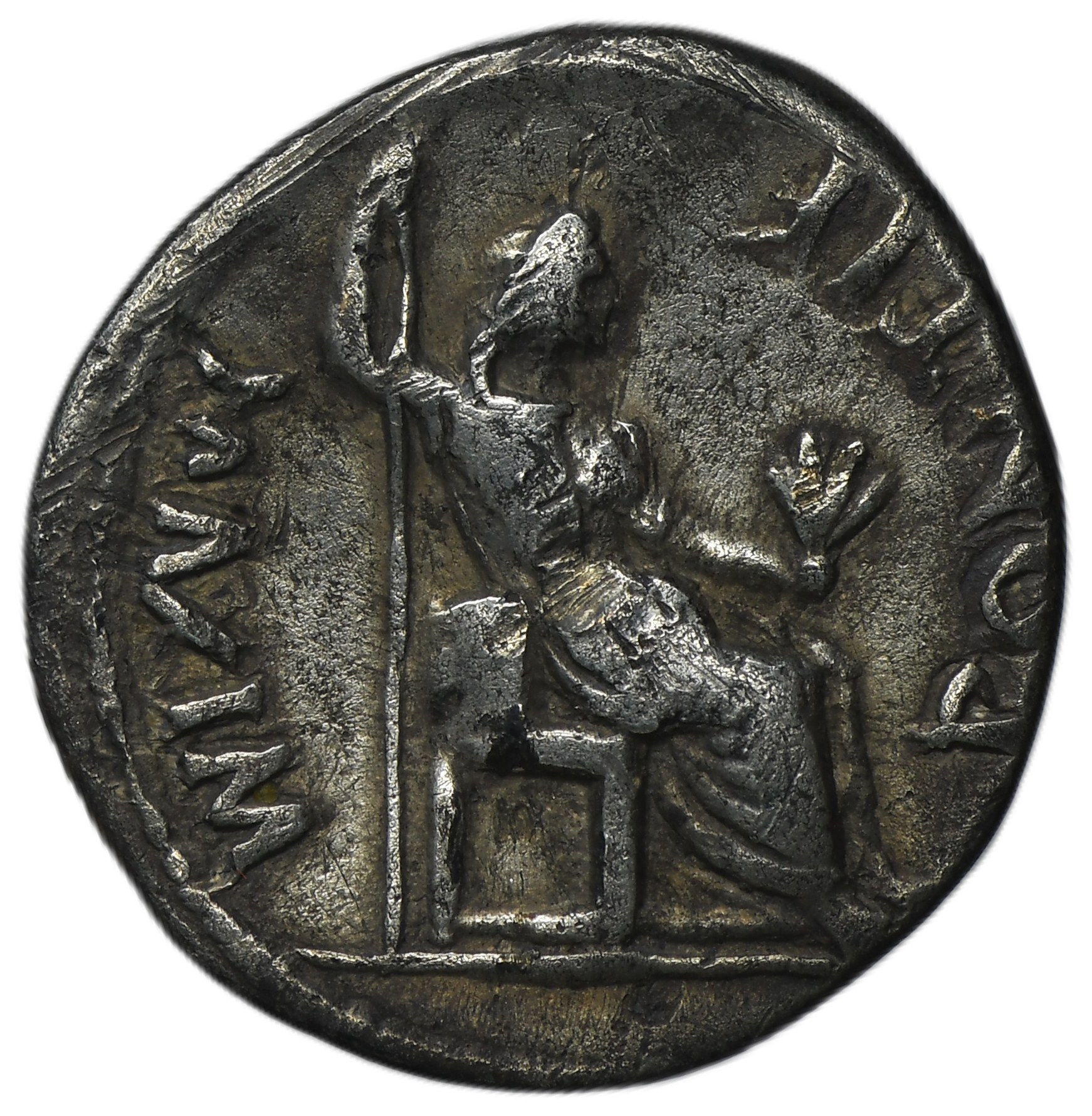


One of the most characteristic issues from the final years of Augustus’ reign, struck at Lugdunum shortly before his death in AD 14. The extensive obverse titulature presents the emperor as son of the deified Caesar (Divi Filius) and Father of the Country (Pater Patriae), emphasising the religious and political foundations of his authority.
Particularly interesting is the reverse, depicting a seated female figure interpreted as Pax, and traditionally also identified as Livia, the wife of Augustus. The sceptre and branch she holds refer to peace and stability – values that occupied a central place in Augustan ideology.
The legend PONTIF MAXIM refers to the office of Pontifex Maximus, the highest priesthood of Roman state religion, which Augustus had held since 12 BC. The coin thus combines the political authority of the princeps with his supreme religious position.
The type acquires additional significance from the period in which it was struck. It dates from the final years of Augustus’ reign, when the political system he had created – the Principate – was already firmly established. Following his death in AD 14, power passed to Tiberius.
The present denarius therefore provides an excellent testimony to the mature ideology of the Augustan Principate – peace, religious authority and political stability centred upon the figure of the princeps. Particularly noteworthy is that the seated reverse figure provided a direct iconographic model for the closely related denarii of Tiberius, commonly known today as the “Tribute Penny” type.
Roman Imperial
Augustus (27 BC - 14 CE), Denarius 13-14, Lugdunum mint (Lyon)
Obverse: laureate head right
CAESAR AVGVSTVS DIVI F PATER PATRIAE
Reverse: Livia (as Pax) seated right on a chair with ornamented legs, holding a long sceptre with her right hand and an olive branch in her left
PONTIF MAXIM
Diameter 20 mm, weight 3.58 g











