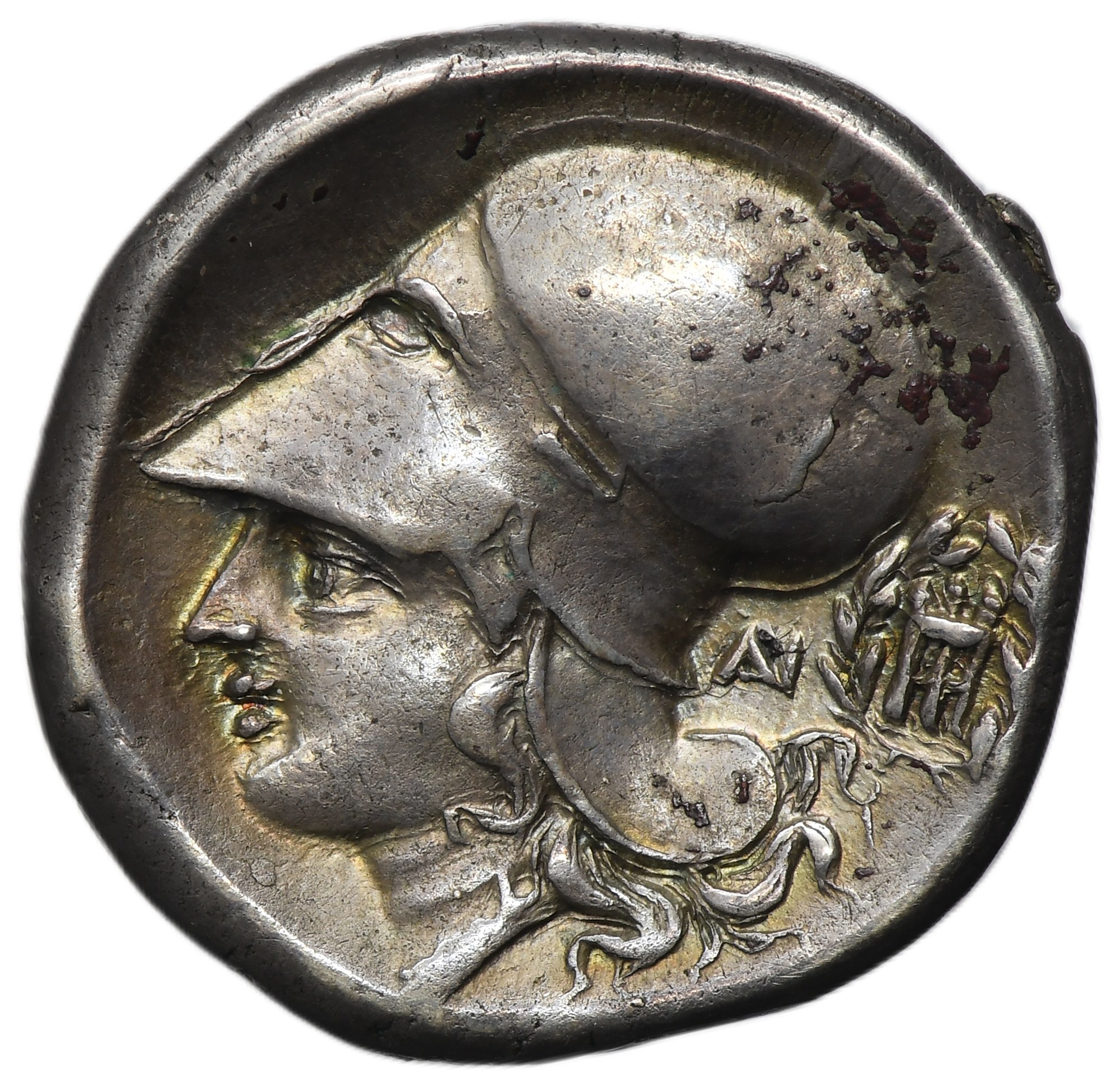
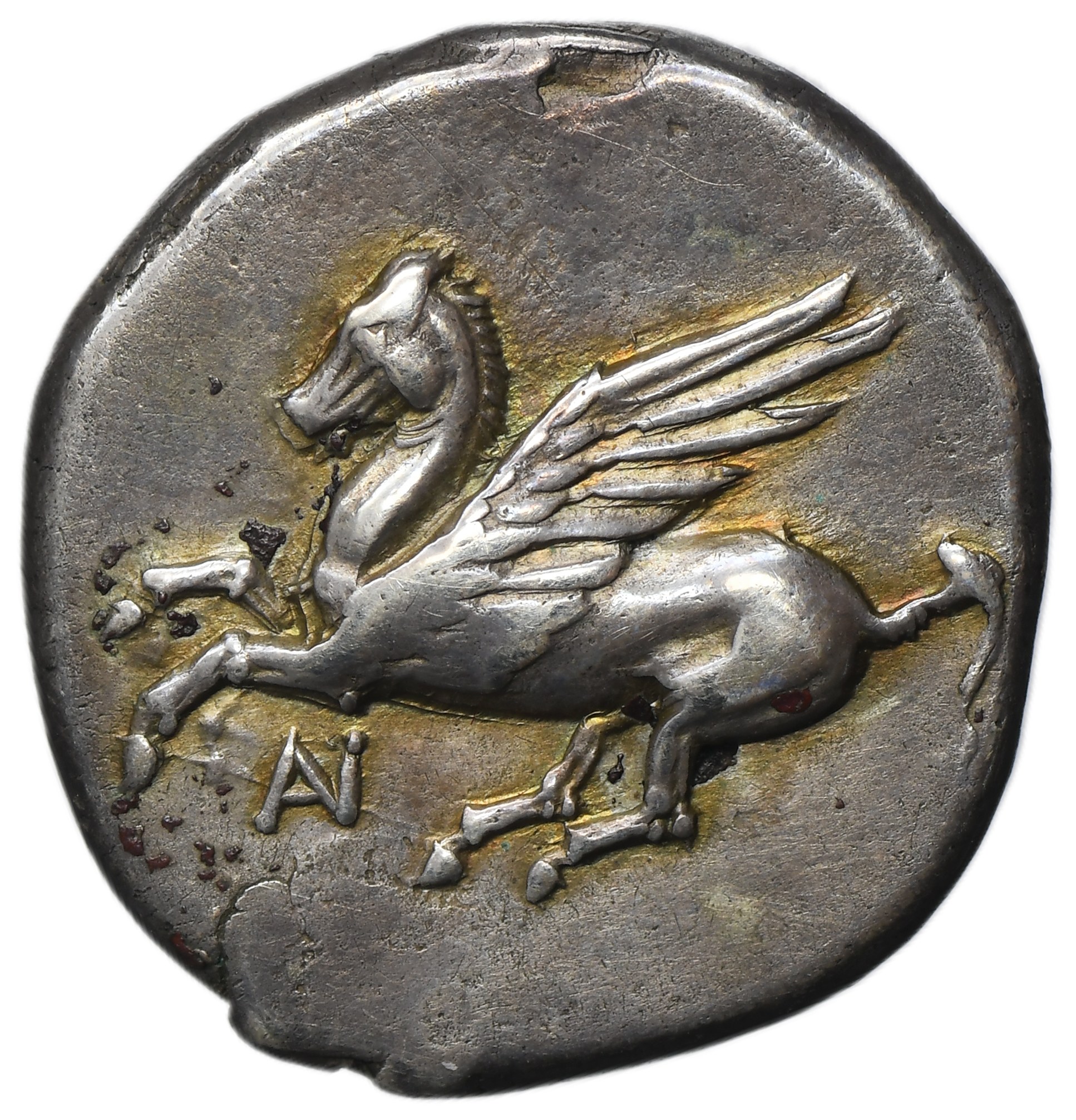
The stater of Anaktorion belongs to the characteristic group of Corinthian-type staters, widely issued and circulated throughout western Greece. Anaktorion, situated in Akarnania at the entrance to the Ambracian Gulf, was founded as a Corinthian colony, and its close ties with the mother city were clearly reflected in its coinage.
The obverse depicts Pegasus flying left, with the letters AN below, identifying the issue with Anaktorion. The reverse features the head of Athena wearing a Corinthian helmet, facing left. Behind the goddess are additional symbols – a monogram and a tripod within a laurel wreath, distinguishing this particular variety within the extensive series.
Pegasus and Athena form the classic iconographic programme adopted directly from Corinthian coinage. According to Greek mythology, Athena helped Bellerophon tame Pegasus by providing him with a golden bridle. The repetition of these motifs on the coinage of Corinthian colonies served as a clear reference to their shared heritage and close connections with the mother city.
Anaktorion’s location along important maritime routes allowed the city to participate in extensive trade networks encompassing Akarnania, Epirus and the Ionian region. Staters bearing the widely recognizable Pegasus and Athena type were well suited to interregional commerce, while letters and additional symbols identified individual local issues.
The present specimen, dated to c. 350–300 BC, is an interesting example of the local adaptation of one of the most recognizable coin types of Classical Greece.
Greece
Akarnania, Anaktorion, Stater 350-300 BC
Obverse: pegasus flying left, letter AN below it
Reverse: head of Athena in Corinthian helmet left, AN monogram and a laurel wreath with a tripod inside
Diameter 22 mm, weight 8.36 g











