
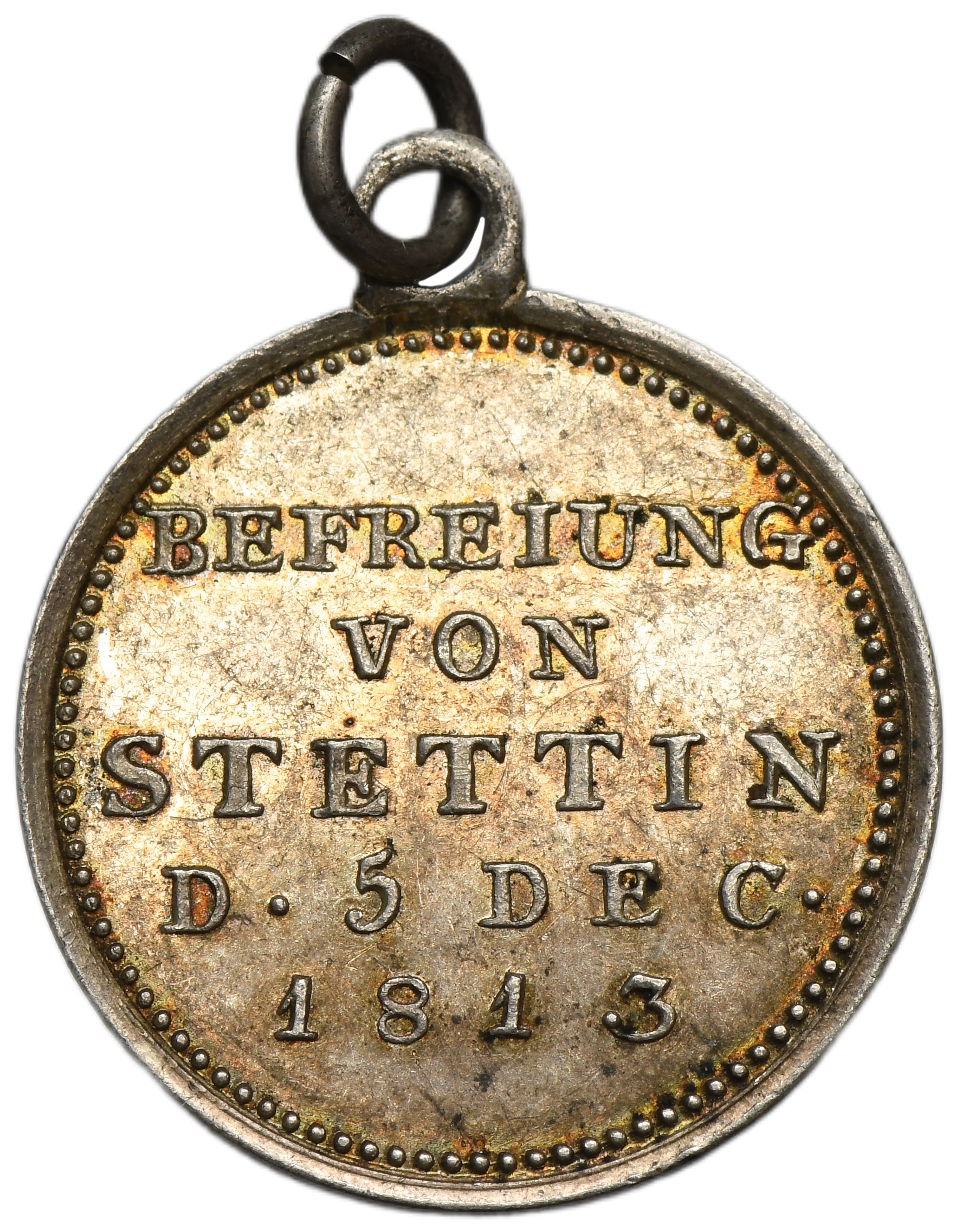
A small silver commemorative medal, known as a Siegespfennig, struck to commemorate the liberation of Stettin, now Szczecin in Poland, from Napoleonic occupation on 5 December 1813. Designed by Daniel Friedrich Loos, it belongs to a series of miniature medals celebrating the victories and major events of the German Wars of Liberation.
Stettin had remained under French control since October 1806, when the Prussian commander surrendered the fortress without resistance. In 1813 its French garrison, numbering several thousand men, was isolated and subjected to a prolonged blockade by Prussian and Russian forces.
The exhaustion of food supplies eventually forced the garrison to surrender. The capitulation was signed on 21 November, and on 5 December 1813, Prussian troops commanded by General Bogislav Friedrich Emanuel von Tauentzien took possession of the fortress. The event ended seven years of French occupation.
The obverse depicts the winged goddess Victory holding a flaming sword and a laurel wreath. The legend GOTT SEGNETE DIE VEREINIGTEN HEERE translates as “God blessed the united armies.”
Fitted with a suspension loop and ring.
An interesting memento of the end of the seven-year Napoleonic occupation and the return of the strategically important fortress of Stettin to Prussian rule.
Obverse: winged Victory holding a flaming sword and a laurel wreath.
GOTT SEGNETE DIE VEREINIGTEN HEERE
Reverse: five-line inscription:
BEFREIUNG / VON / STETTIN / D. 5 DEC. / 1813
Silver, diameter 15 mm, weight 1.44 g











