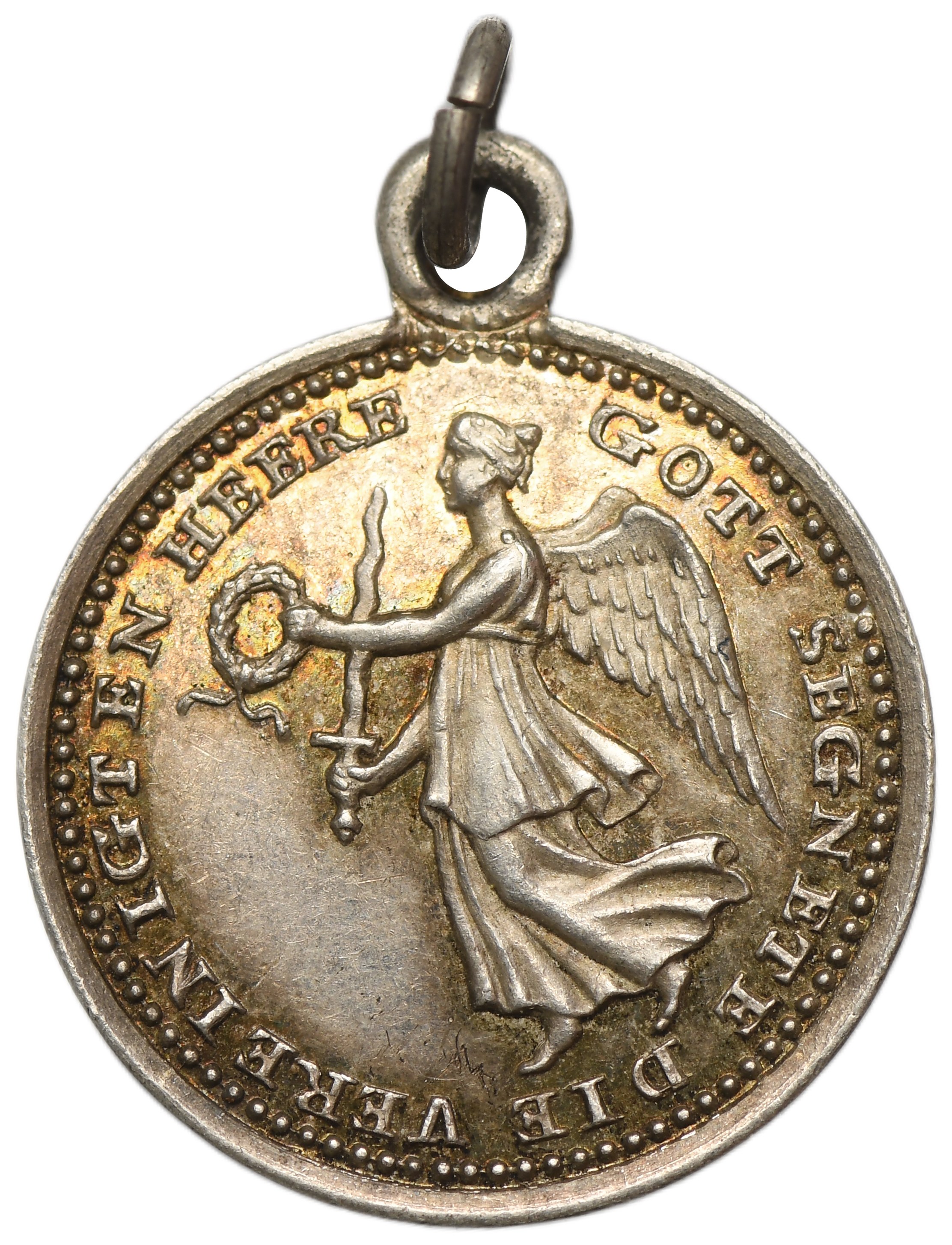
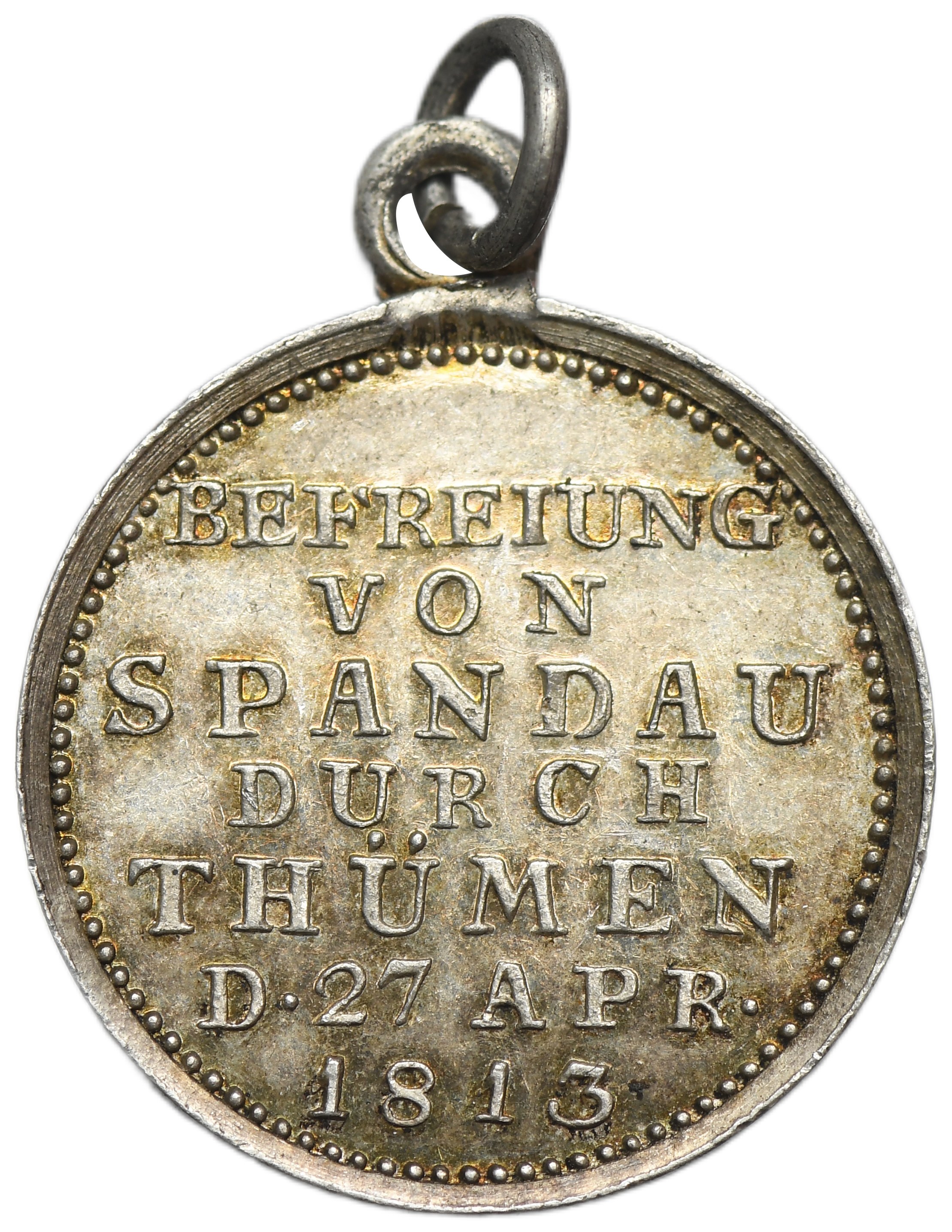
A small silver commemorative medal, known as a Siegespfennig, struck to commemorate the liberation of the Spandau fortress from Napoleonic occupation on 27 April 1813. Designed by Daniel Friedrich Loos, it belongs to a series of miniature medals celebrating Allied victories during the German campaign against Napoleon.
Spandau and its imposing citadel had remained under French control since Prussia’s capitulation in 1806. In the spring of 1813, the fortress was besieged by Prussian forces commanded by Major General August von Thümen, despite their numerical inferiority to the French garrison and limited siege equipment.
Following several days of bombardment, during which the powder magazine in the Queen’s Bastion exploded, the French commander agreed to capitulate. On 27 April 1813, the garrison evacuated the citadel and the Prussian forces took possession of this strategically important fortress protecting the approaches to Berlin. Accordingly, the medal’s inscription refers not to a battle, but to the liberation of Spandau by Thümen.
The obverse depicts Victoria, the winged goddess of victory, holding a flaming sword and a laurel wreath. The surrounding inscription GOTT SEGNETE DIE VEREINIGTEN HEERE translates as “God blessed the united armies.”
Medal with a suspension loop and ring.
An interesting relic of the Napoleonic Wars, commemorating the recapture of one of the most important fortresses defending the approaches to Berlin.
Obverse: Winged Victoria holding a flaming sword and laurel wreath.
GOTT SEGNETE DIE VEREINIGTEN HEERE
Reverse: Inscription in seven lines:
BEFREIUNG / VON / SPANDAU / DURCH / THÜMEN / D. 27 APR. / 1813
Silver, diameter 15 mm, weight 1.47 g











