
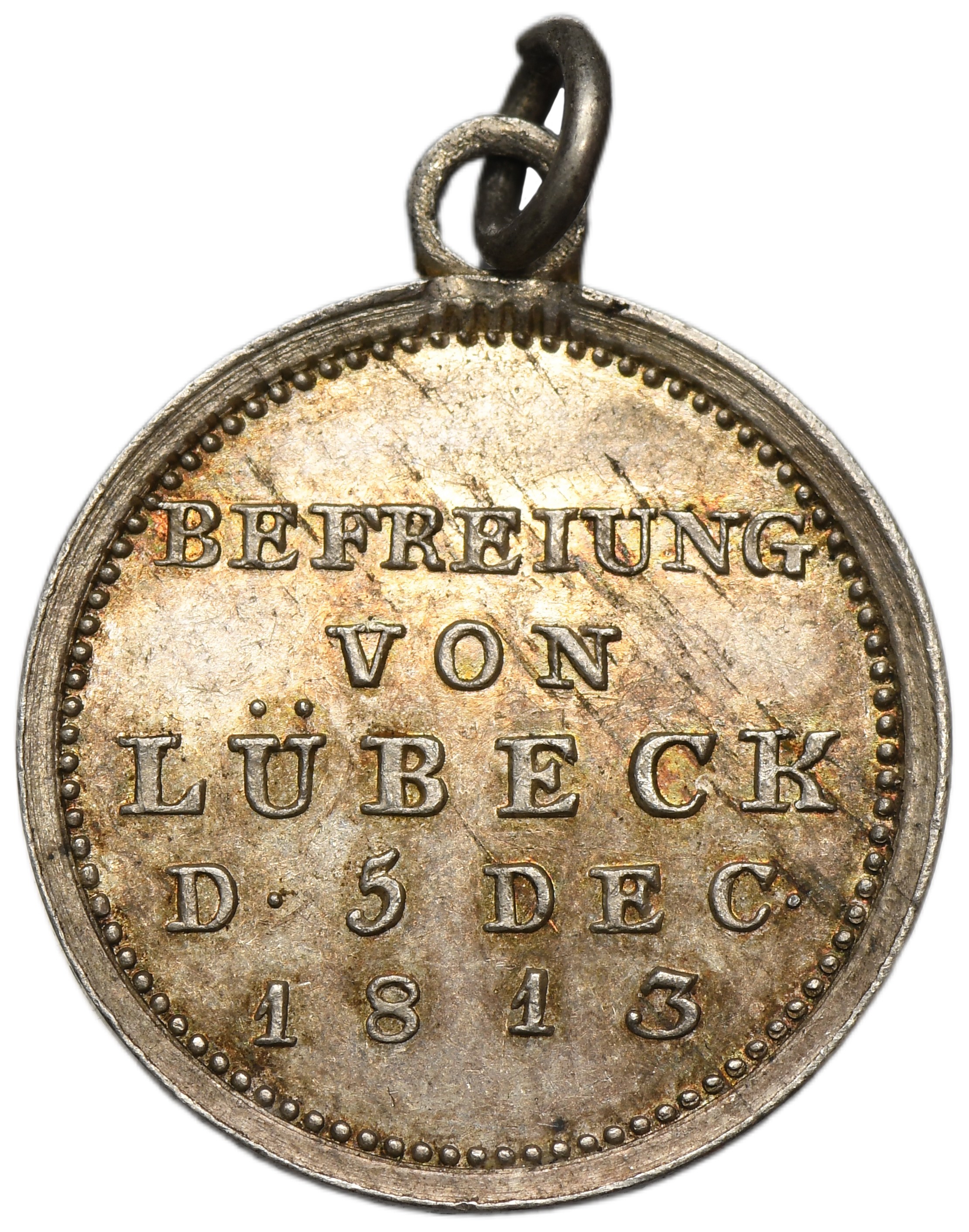
A small silver commemorative medal, known as a Siegespfennig, struck to commemorate the liberation of Lübeck from Napoleonic occupation on 5 December 1813. Designed by Daniel Friedrich Loos, it belongs to a series of miniature medals celebrating the victories and major events of the German Wars of Liberation.
Lübeck had remained under French control since 1806 and was formally incorporated into the French Empire in 1811. The occupation imposed severe financial burdens on the city and contributed to the collapse of its maritime trade, further aggravated by the Continental Blockade.
Following Napoleon’s defeat at Leipzig, the French forces commanded by Marshal Louis-Nicolas Davout concentrated around Hamburg. On 5 December 1813, the French garrison withdrew from Lübeck, and Allied forces under the Swedish Crown Prince Charles John Bernadotte entered the city. This marked the definitive end of French rule and enabled the restoration of Lübeck’s former political order.
The obverse depicts the winged goddess Victory holding a flaming sword and a laurel wreath. The legend GOTT SEGNETE DIE VEREINIGTEN HEERE translates as “God blessed the united armies.”
Fitted with a suspension loop and ring.
An interesting memento of the liberation of Lübeck and the end of the period of French domination that had begun in 1806.
Obverse: winged Victory holding a flaming sword and a laurel wreath
GOTT SEGNETE DIE VEREINIGTEN HEERE
Reverse: five-line inscription
BEFREIUNG / VON / LUBECK / D. 5 DEC. / 1813
Silver, diameter 15 mm, weight 1.53 g











